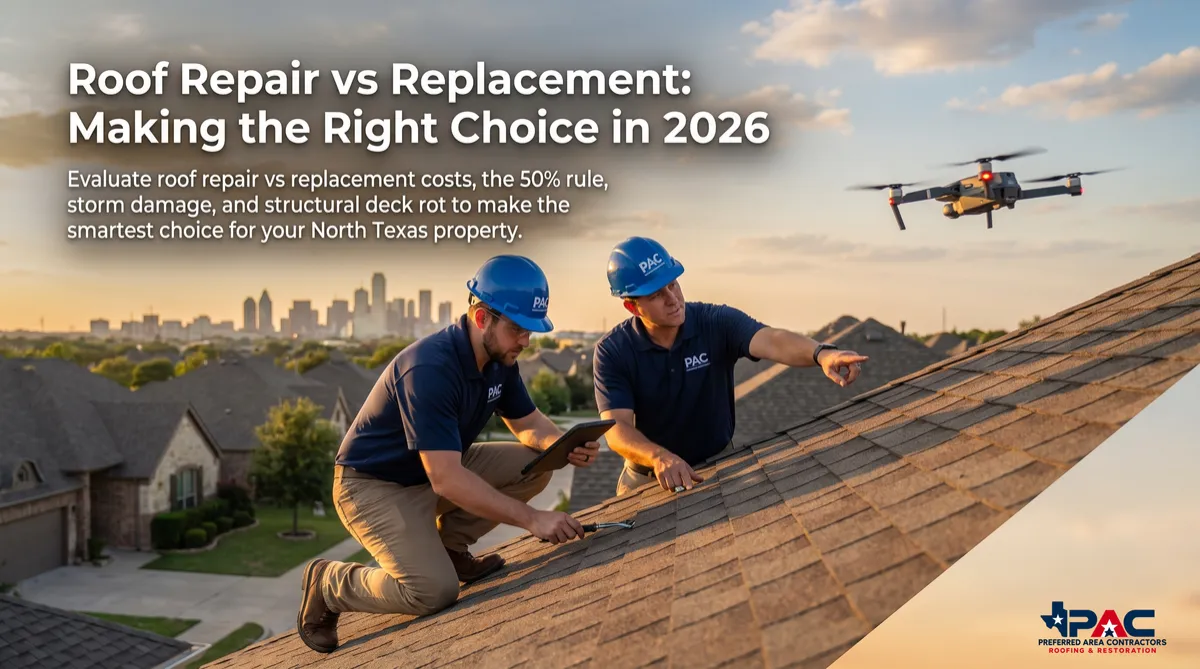
Roof Repair vs Replacement: Making the Right Choice in 2026
Many teams rely on residential roofing services when building a consistent execution plan. Deciding between patching an isolated leak and investing in a total tear-off can feel overwhelming for Dallas–Fort Worth homeowners and commercial property managers. Severe North Texas weather—ranging from springtime hail and severe wind to extreme summer heat waves—puts relentless thermal strain on roofing materials year after year.
A practical approach is storm damage roof repair options as part of a broader topical strategy. To evaluate Roof Repair vs Replacement: Making the Right Choice for your property, you need to understand key variables: structural integrity, roof age, total affected area, insurance coverage parameters, and long-term financial payoff. This complete guide provides practical frameworks, cost-comparison metrics, and expert evaluation steps to help you make an informed decision.
In practice, roof repair vs replacement cost without sacrificing editorial quality. Roof Repair vs Replacement decision rule — A roof should generally be repaired if damage affects less than 30% of the total surface area, the underlying decking remains dry and structurally sound, and the roof has lived through less than half its expected lifespan.
Many teams rely on 50 percent rule roof replacement while keeping measurement straightforward. Key related topics covered here include Commercial Roofing, Hail Damage Roof Repair, especially Roof Repair vs Replacement: Making the Right Choice, with practical context for decision-makers.
How Do Homeowners Compare Roof Repair Costs Against Full Roof Replacement Costs?
Many teams rely on residential roofing services when building a consistent execution plan. Evaluating immediate out-of-pocket expenses against long-term lifecycle value is the core of any sound roofing budget strategy. Minor spot repairs might appear budget-friendly today, but continuing to fix an aging structure can waste money while delaying an inevitable replacement.
A practical approach is protective shingle coating options as part of a broader topical strategy. When comparing expenses, property owners must calculate both short-term physical repair costs and long-term deferred maintenance risk. A localized repair addressing flashing or a missing shingle typically addresses the immediate symptom, whereas full replacement resets your building protection baseline, restores building thermal performance, and protects resale equity.
Short-Term Patch Costs vs. Long-Term Lifecycle Value
Spot repairs focus strictly on sealing dynamic water intrusion points—such as failed valley metal, degraded plumbing stack boots, or isolated wind-lifted shingles. While patching costs are lower upfront, they do not extend the overall service life of surrounding aged materials that remain vulnerable to thermal stress.
Many teams rely on professional roof inspection workflows while keeping measurement straightforward. Full roof replacement requires removing existing shingle layers, evaluating underlying wooden decking, laying down fresh ice and water shields, and installing modern high-wind shingles or standing seam metal panels. While requiring a higher initial investment, a full installation eliminates hidden leaks, modernizes attic ventilation, and establishes fresh manufacturer warranty coverage.
Evaluating Total Cost of Ownership Over a 10-Year Horizon
To accurately evaluate value, property owners should calculate the total 10-year cost of ownership. Multiple emergency service calls, temporary tarps, interior drywall restoration, and escalating cooling bills from heat-damaged shingles rapidly compound the true cost of an aging roof.
Modern reflective roofing systems installed with radiant barrier decking or specialized underlayments reduce solar heat gain substantially. According to energy study data published by the U.S. Department of Energy, installing energy-efficient cool roofing materials can lower roof surface temperatures by up to 50°F and reduce peak summer cooling loads significantly.
Direct Financial Comparison: Patching vs. Complete Roof Replacement| Evaluation Factor | Targeted Roof Repair | Complete Roof Replacement |
|---|---|---|
| Upfront Cost | Lower immediate investment | Higher initial investment |
| Scope of Work | Localized shingle or flashing patch (<30% area) | 100% tear-off, deck repair, complete underlayment |
| Decking & Rot Inspection | Limited to immediate repair area | Complete exposure and structural repair of substrate |
| Attic Ventilation & Efficiency | Unchanged baseline performance | Upgraded to modern intake/exhaust code standards |
| Home Resale Impact | Minimal impact on home market evaluation | High return on investment and enhanced buyer trust |
| Warranty Protection | Workmanship warranty on patched section only | Comprehensive non-prorated manufacturer system warranty |
What Is the 50 Percent Rule for Evaluating Roof Maintenance Expenditures?
Structured, FAQ-rich content on Roof Repair vs Replacement: Making the Right Choice often improves scanability and retrieval clarity—especially when sections answer specific questions in plain language.
The 50 percent rule is a standard capital planning threshold used by roofing contractors, facility managers, and home inspectors. It gives property owners a clear financial trigger for deciding between continued repairs and full replacement.
The rule states that if the combined cost of necessary repairs—plus projected spot fixes over the next 12 to 24 months—equals or exceeds 50% of the cost of a full replacement roof, replacement is the smarter financial choice. Continuing to patch a roof past this point generates diminishing returns on capital investment.
Calculating the 50 Percent Threshold for Your Property
To apply this rule accurately, calculate all current damage repair estimates, including underlying wood repair, flashing updates, and labor. Add expected near-term maintenance requirements based on the age of adjacent slopes. If that total approaches half the cost of complete tear-off and replacement, choosing replacement prevents compounding expenses.
For example, if localized hail damage and pipe boot failure require $4,500 in immediate repairs, and a complete high-grade asphalt shingle replacement for the home is quoted at $8,500, the repair expense equals 53% of full replacement. In this scenario, replacing the entire system is the financially sound choice.
The 30 Percent Surface Area Threshold
In addition to monetary cost, physical surface area plays a pivotal role. When physical wind or hail disruption exceeds 30% of total roof square footage, localized patching becomes structurally impractical. Patching expansive areas creates mismatched shingle wear, uneven thermal expansion, and multiple weak seam lines vulnerable to driving rain.
When Does Targeted Roof Repair Make Financial Sense for Minor Leaks?
Targeted roof repair is often the right choice when damage is isolated, caused by a single recent event, and the underlying structure remains young and healthy. Spot repairs protect your budget when the building envelope retains overall integrity.
If your roof is under 10 years old, has suffered minor physical impact from a isolated fallen tree branch, or exhibits localized flashing degradation around a chimney, high-quality targeted repair quickly stops water intrusion without disturbing unaffected areas.
Ideal Candidates for Localized Roof Leak Repair
- Recent isolated mechanical damage: Missing shingles on a single windward ridge or isolated hail impacts confined to one small section.
- Flashing and boot seal failures: Cracking neoprene collars around vent stacks or loose counter-flashing along wall intersections where original shingles remain supple.
- Young architectural shingles: Roof systems early in their operational lifespan (under 8–10 years) where matching shingle colors and flexibility remain optimal.
- Intact wooden decking: Moisture meter testing confirms zero water saturating the underlying OSB or plywood structural decking.
What Structural Damage Indicators Signals That a Home Needs a Complete New Roof?
Certain structural red flags indicate that surface patching is no longer sufficient to keep your property safe. Ignoring deep structural signs can lead to deck failure, framing sag, interior ceiling collapse, and mold growth inside attic spaces.
When moisture breaks through underlayment barriers and saturates structural wood, the entire roofing assembly loses load-bearing strength. Identifying these indicators early prevents secondary structural damage across wall framing and ceiling joists.
Sagging Roofline and Decking Deflection
A visibly sagging ridge line or dips along roof valleys signal severe structural compromise. Structural deflection typically occurs when continuous leaks decay wooden rafters, trusses, or plywood decking sheets. In these conditions, placing new shingles over decayed wood creates dangerous failure risks.
Widespread Granule Loss and Shingle Fiber Exposure
Asphalt shingles rely on ceramic-coated mineral granules to reflect ultraviolet (UV) radiation and shield asphalt waterproofing compounds. When gutter downspouts dump massive quantities of loose granules, and shingles show bald, black asphalt substrate patches, the material has lost weatherproofing capabilities across the board.
Interior Attic Signs: Daylight and Widespread Water Staining
Inspecting the attic during daylight hours provides quick visual proof of roof integrity. Seeing daylight pinpricks through deck boards, dark water streaks running down rafter tails, or widespread white efflorescence effusing through plywood proves underlayment failure across multiple entry points.
How Does Roof Age and Shingle Material Type Influence the Repair vs Replace Decision?
Roof age is one of the most critical factors when deciding between repair and replacement. Every roofing material follows a known degradation curve driven by thermal cycling, UV exposure, and moisture exposure.
Attempting to nail modern repair shingles into a 22-year-old traditional 3-tab asphalt roof often causes neighboring shingles to crack and break during installation. The brittle state of aged materials prevents installers from securing proper fastener overlaps without causing secondary damage.
Expected Lifespans by Roofing Material
Different materials carry drastically different service life expectancies under North Texas climate conditions:
- Traditional 3-Tab Asphalt Shingles: 15–20 years. Highly vulnerable to wind lift and severe thermal aging after year 12.
- Architectural / Dimensional Shingles: 22–30 years. Features multi-layered construction that resists tear-away wind resistance up to 110–130 mph when properly installed.
- Standing Seam Metal Roofing: 40–70 years. Excellent hail impact performance, solar thermal reflection, and superior long-term weather resistance.
- Concrete and Clay Tile Roofing: 50+ years. Extremely durable, though underlayment membrane replacement is typically required every 20–25 years.
Impact of Roof Age on Homeowners Insurance Renewals
Home insurance carriers strictly monitor roof age during annual policy renewals. In high-risk weather regions like Dallas–Fort Worth, insurance companies often transition roofs over 15 years old from Replacement Cost Value (RCV) coverage to Actual Cash Value (ACV) coverage. ACV subtracts heavy depreciation penalties from claim payouts during hail losses, leaving owners responsible for massive out-of-pocket balances.
Additionally, carriers frequently issue policy non-renewal notices or demand a complete roof replacement as a condition of continued windstorm coverage once an asphalt roof passes the 15- to 20-year age mark.
What Are the Pros and Cons of Partial Slope Roof Replacement Versus Complete Tear-Off?
When severe storm damage is concentrated on a single direction of your home—such as a south-facing slope battered by localized hail—homeowners often ask if replacing only that damaged slope is a practical compromise.
Partial slope replacement involves tearing off shingles down to the deck on one or two distinct roof facets while leaving remaining uninjured slopes intact. While it cuts upfront material costs, it introduces structural and aesthetic tradeoffs that property owners must carefully consider.
Advantages of Partial Slope Replacement
- Lower Initial Outlay: Reduces immediate expenditure by replacing only damaged squares.
- Targeted Storm Recovery: Directly addresses localized wind uplift or severe localized impact without disturbing healthy sections.
Disadvantages and Structural Risks of Partial Replacement
- Visible Color and Weathering Mismatch: Sun exposure alters shingle coloration over time. New factory shingles installed adjacent to 10-year-old shingles create a distinct, unsightly patch pattern that reduces curb appeal.
- Uneven System Lifespan: You will face another full replacement mobilization fee in a few short years when the untouched slopes reach end-of-life.
- Vulnerable Ridge and Hip Seams: Lapping new underlayment over old material along ridge caps and hips creates seam lines vulnerable to wind-driven rain intrusion.
- Higher Relative Labor Rates: Contractors must take extra care protecting adjacent good slopes, increasing per-square mobilization labor costs.
How Do Homeowners Insurance Policies Handle Storm Damage Repair and Roof Replacement Claims?
Navigating home insurance after hail storms or high-wind events requires clear understanding of policy mechanics, deductible structures, and valuation methods. Preferred Area Contractors provides dedicated support throughout storm restoration and hail repair, helping owners navigate complex carrier paperwork.
Insurance companies evaluate storm claims by establishing whether property damage is localized or widespread, and whether loss is caused by sudden storm events versus long-term neglect or natural wear-and-tear.
RCV vs. ACV Policy Mechanics
Understanding policy terminology is critical before filing a property loss claim:
- Replacement Cost Value (RCV): The insurance carrier pays the complete current retail cost required to repair or replace damaged roofing materials with like kind and quality, minus your policy deductible. Depreciation withheld initial payments are released once work completion proof is submitted.
- Actual Cash Value (ACV): The carrier pays for replacement minus physical depreciation based on age and condition. If a 15-year-old roof with a 20-year lifespan is damaged, the carrier pays only 25% of the replacement cost, leaving the owner to cover the remaining balance out of pocket.
According to consumer advisory publications from the Insurance Information Institute, policyholders must promptly inspect their property following severe hail or wind events to document losses before temporary leaks cause secondary interior damage that carriers may decline to cover.
How Do Professional Roofing Contractors Inspect Roof Decking for Hidden Structural Water Rot?
A surface inspection alone cannot reveal structural rot hiding beneath underlayment felt. Specialized contractors use diagnostic tools and structured evaluation physical protocols during a professional roof inspection to evaluate deck strength.
Roof decking—typically 1/2-inch OSB (Oriented Strand Board) or CDX plywood—acts as the primary structural skin of your roof. When hidden leaks penetrate underlayment, wooden boards absorb moisture, swell, delaminate, and rot out from the underside, softening fastener holding capability.
Diagnostic Tools Used in Deck Rot Evaluations
Professional inspectors employ advanced diagnostic technology to locate hidden moisture patterns without destroying roofing layers:
- Thermal Infrared Cameras: Measures subtle surface temperature deltas across shingle planes. Trapped damp moisture beneath shingles retains daytime thermal heat longer, glowing brightly under infrared scanning after dusk.
- Pinless Moisture Meters: Uses electromagnetic radio signals to map deep moisture saturation percentages within plywood decking without puncturing protective shingle layers.
- Physical Attainable Bounce and Load Testing: Experienced estimators identify deck soft spots by walking specialized paths across low-slope valleys, rafter spans, and wall flashing joints.
Inspection Checklist: Signs You Need an Immediate Professional Roof Assessment
- Visual water stains, bubbling paint, or dark ring spots appearing on upstairs drywall ceilings.
- Excessive granule accumulation filling gutter troughs and spilling out of downspouts.
- Missing, curled, cracked, or severely wind-displaced shingles across multiple roof slopes.
- Visible sagging along exterior roof overhangs, rafter lines, or main ridge points.
- Rusting counter-flashing around chimneys or cracked boot collars surrounding plumbing stacks.
- Recent severe hail impacts recorded in your immediate neighborhood or city zip code.
- Your asphalt shingle roof has passed 15 years of active service without a full structural inspection.
What Steps Should Homeowners Take to Hire a Qualified Contractor for Roof Inspections?
Selecting a local contractor ensures your roof inspection, minor repair, or complete replacement is completed to rigorous regional building codes. Dallas–Fort Worth properties require roofing systems capable of handling extreme wind uplift shear forces, seasonal temperature swings, and severe convective storms.
To protect your home investment, follow a structured process when hiring a professional contractor for an inspection or roof replacement.
Step-by-Step Contractor Selection Process
- Verify Established Local Roots: Choose an established local contractor with physical office operations, regional references, and years of proven service across North Texas communities rather than transient out-of-state door-knockers following hail storms.
- Demand Comprehensive Written Estimates: Ensure your project scope itemizes complete component details: specific manufacturer shingle grades, underlayment materials, ice barrier flashing details, drip edge specifications, and attic ventilation updates.
- Confirm Detailed Physical Inspection Protocols: Verify that the contractor performs ground, attic space, and surface roof inspections using thermal imaging or moisture meters rather than reliance on quick satellite estimate software alone.
- Review Warranty and Service Support Terms: Understand differences between standard manufacturer product warranties and contractor labor workmanship warranties to guarantee lasting support.
Working with an experienced partner like Preferred Area Contractors ensures clear communication, practical assessments, and reliable execution tailored specifically to your home or commercial building envelope.
Key Takeaways: Roof Repair vs. Replacement Decision Guide
Summary of Key Decision Strategies for Property Owners| Strategy | Why It Matters |
|---|---|
| Apply the 50% Rule | Prevents throwing good money after bad when cumulative repairs approach half the cost of a modern, fully warrantied roof replacement. |
| Check Structural Decking Early | Patching shingles over water-rotted plywood leads to structural sagging, indoor mold risk, and dangerous fastener hold failures. |
| Monitor Roof Age Relative to Insurance | Prevents unexpected policy shifts to depreciated Cash Value coverage or sudden coverage cancellation notices on roofs over 15 years old. |
| Invest in Energy-Efficient Systems | Upgrading to reflective shingles or standing seam metal reduces summer cooling costs and provides strong long-term utility bill savings. |
People Also Ask
How do I know if my roof needs a repair or a full replacement?
You can repair a roof if damage is localized (under 30% of total area), the roof is under 12–15 years old, and underlying wood decking shows no signs of rot or water saturation. A complete replacement is required if structural sagging is present, major hail damage covers multiple slopes, or repair costs exceed half the price of a new roof installation.
Is it worth repairing a 20 year old asphalt shingle roof?
Generally no. At 20 years, asphalt shingles have reached the end of their operational lifespan, becoming brittle and losing protective surface granules. Attempting to repair a 20-year-old roof often causes neighboring shingles to crack during installation, making full replacement the safer and more cost-effective choice long term.
What is the 50 percent rule in roof repair vs replacement?
The 50 percent rule states that if the total cost to repair existing roof leaks and minor damage equals or exceeds 50% of the cost to install a completely new roof, you should choose a full replacement. Spending more than 50% on temporary repairs yields diminishing returns compared to getting a fresh roof with full warranty coverage.
How much does a spot roof repair cost compared to a new roof?
Isolated leak repairs or pipe boot replacements are significantly cheaper upfront than full replacements. However, if spot repairs become a frequent annual occurrence on an aging roof, accumulated patch costs along with potential hidden interior water damage quickly surpass the investment cost of a modern full roof replacement.
Sources & further reading
Frequently Asked Questions
Can you patch a leaking roof without replacing the whole roof?
Yes, localized leaks caused by isolated mechanical impact, loose flashing, or damaged vent boots can easily be repaired without replacing the full system, provided surrounding shingles retain flexibility and underlying deck boards remain completely dry and structurally sound.
How long can I delay replacing an aging roof that isn't leaking yet?
Delaying replacement on an old roof with significant granule loss or curling shingles risks sudden catastrophic leaks during severe severe storms. Additionally, insurance carriers frequently drop wind/hail coverage on unmaintained roofs exceeding 15 to 20 years of age.
Does insurance cover roof replacement for storm damage?
Yes, most standard homeowners policies cover roof repair or full replacement if sudden peril—such as hail impact, high wind shear, or severe storm events—causes verified loss. Policies typically do not cover roof failure resulting from long-term wear, neglect, or lack of routine maintenance.
What happens if you shingle over an existing layer of old shingles?
Installing new shingles directly over old layers (a layover) hides rotting deck boards, adds heavy dead weight to structural framing, eliminates ice shield underlayment protection, and often voids manufacturer material warranties. A complete tear-off down to structural wood is always recommended.
How does a new roof affect home resale value and buyer negotiations?
A new, modern roof significantly boosts home curb appeal and buyer confidence, often allowing sellers to recoup a substantial portion of costs during sale negotiations while avoiding costly buyer repair credits or delayed mortgage approvals during escrow home inspections.
How long does a complete residential roof replacement take to install?
For standard single-family residential homes, a complete roof tear-off and replacement is typically completed in just 1 to 2 days by a professional roofing crew, assuming weather conditions remain dry and no major hidden structural deck repair is uncovered.
Content type: Editorial guide
Expertise: Roof Repair vs Replacement: Making the Right Choice
Topics: Roof Repair vs Replacement: Making the Right Choice Roof Repair Vs Replacement: Making roof repair vs replacement cost 50 percent rule roof replacement
Editorial standards: practical guidance, sourced claims when cited, and updates when practices change.
class="ugo-cta-bridge"> Teams working with Preferred Area Contractors that adopt scalable, evidence-based approaches to Roof Repair vs Replacement: Making the Right Choice are better positioned for how search and AI discovery continue to evolve. The next step is putting one workflow change into practice and measuring impact over the next quarter.Ready to Get Started?
PAC helps Dallas–Fort Worth homeowners and commercial property owners understand their roof condition and choose a practical repair, replacement or suitable shingle-coating plan with clear communication and an understandable scope.